Entremets

4.21.2018
Pear Caramel Chocolate Cake


If there is a cake for every season, I think this pear caramel chocolate cake is a strong contender for autumn. Maybe it's the golden caramel colour. It reminds me of yellow gold autumn leaves and russet brown bosc pears. I didn't use bosc pears for this cake though, but the packham which I trust for holding its shape when poached or saute.
There are 6 components to this cake- chocolate sponge, vanilla syrup, caramelised pears, caramel sauce, caramel mousse and crushed caramel. The cake is fairly easy to make, especially if you work with caramel before.
This is the type of cake I love to make and eat. It is light, and surprisingly with the amount of caramel in this cake, not overly sweet. And of course, we can't go wrong with the classic flavour combination of pear, caramel and chocolate.


Pear Caramel Chocolate Cake
(adapted from Patisserie by Christophe Felder)
Makes 15cm cake
Vanilla Syrup
35ml water
25 grams caster sugar
1/2 teaspoon vanilla extract
To make vanilla syrup:
Combine the water, sugar and vanilla extract in a small saucepan over medium heat, stirring until sugar dissolves, bring to a simmer for 1 minute. Remove from heat and set aside to allow to cool completely.
Chocolate Sponge Cake
75 grams plain flour
20 grams dutch-processed cocoa powder
120 grams egg whites (about 4)
60 grams caster sugar
60 grams egg yolks (about 3)
To make chocolate sponge cake:
Preheat oven to 160 degrees celcius fan-force. Line 2 baking trays with baking paper.
Combine and sift flour and cocoa powder. Set aside.
Using an electric mixer fitted with a whisk attachment, whisk the egg whites at medium speed until foamy. Gradually add sugar and whisk until stiff peaks form. Add egg yolks and whisk until combine, about 5 seconds.
Remove bowl from mixer, and gently fold the flour and cocoa powder mixture into the egg mixture with a flexible spatula.
Spoon the cake batter into a piping bag fitted with 1cm plain tip. Pipe half into 16cm circle on each of the prepared baking trays.
Bake for 10-12 minutes, until just firm to touch. Transfer cakes to a rack to cool completely.
Caramelised Pears
1 vanilla bean
25 grams caster sugar
300 grams peeled and diced pears (I used packham pears)
To make caramelised pears:
Split the vanilla beans lengthwise in half and scrape out the seeds.
Place sugar in a small frypan or skillet over medium-high heat. Allow sugar to melt and turns a light amber colour. (Tip: when sugar starts to brown in spots, rather than stirring which cause crystallization, gently swirl the pan to even out the colour and keep the hot spot from burning.)
Add the pears and vanilla beans and seeds and cook, stirring until tender and caramelised on all sides, about 5 minutes. (Tip: you might find that the caramel will seize up when you add the pears. It's fine. Keep stirring until the caramel liquefy and completely coats the pears. Don't be afraid to turn down the heat to low if required.)
Remove from heat and allow to cool completely. Remove the vanilla beam.
Caramel Sauce
75ml heavy cream
30 grams caster sugar
15 grams unsalted butter
To make caramel sauce:
Warm heavy cream in microwave oven for 30 seconds. This will make it easier to combine with the caramel then if it were cold.
Place sugar in a small saucepan over medium-high heat. Allow sugar to melt and turns to a medium amber caramel. (Tip: when sugar starts to brown in spots, rather than stirring which cause crystallization, gently swirl the pan to even out the colour and keep the hot spot from burning. Lift pan from heat while swirl the pan. And don't be afraid to turn down the heat to low if required.)
Carefully pour the cream into the caramel in three batches, stirring with a wooden spoon after each addition until smooth.
Add the butter and cook over medium heat until the caramel sauce is creamy and smooth, about 10 seconds. Remove from heat.
Caramel Mousse
100 grams caster sugar
30ml water
3 gold strength gelatine sheets (2 grams per sheet)
60 grams egg yolks (about 3)
1 tablespoon caster sugar
125ml milk
300ml heavy cream, cold
To make caramel mousse:
Note: make caramel mousse only when you have make all the above components and are ready to assemble the cake.
Place sugar in a small saucepan over medium-high heat. Allow sugar to melt and turns to a dark amber colour. (Tip: when sugar starts to brown in spots, rather than stirring which cause crystallization, gently swirl the pan to even out the colour and keep the hot spot from burning. Lift pan from heat while swirl the pan. And don't be afraid to turn down the heat to low if required.)
Carefully stir in water. This will reduce the temperature, so slightly reheat the caramel. (Tip: you might find that the caramel will seize up when you add the water. It's fine. Keep stirring until the caramel liquefy. Don't be afraid to turn down the heat to low if required.) Remove from the heat.
Soak the gelatine sheets in a bowl of cool water. Set aside while you are making the custard.
Whisk egg yolks and 1 tablespoon caster sugar in a bowl until light and creamy and sugar dissolves.
Bring the milk to a boil in a small saucepan. Whisk it into the egg yolks and return the custard to the saucepan. Pour in the watered-down caramel. Cook over low heat, stirring constantly with a wooden spoon, until the custard thickens slightly and coats the back of the spoon.
Squeeze the gelatine sheets dry and stir it into the caramel custard with a wooden spoon until dissolves. Cover surface of caramel custard with plastic wrap. Let the mixture cool, but be careful that it does not set. If it does, reheat it very slightly.
Whip the cream until it folds a firm peak.
Fold one-third of the whipped cream into the cooled caramel custard to lightened it. Gently fold the caramel custard into the remaining whipped cream with a flexible spatula until smooth.
To assemble (part 1):
Place the 15cm diameter x 5cm high cake ring on one sponge cake. Cut off the excess. Repeat with the second sponge cake. Leave one of the sponge cake in the cake ring.
Brush the cake in the ring with vanilla syrup.
Spread the diced pears in the ring over the cake. Reserve some of the pears for decorating if you like.
Pour the caramel sauce over the pears. (Tip: if the caramel sauce thickens too much becomes too difficult to spread over the pears, heat in the microwave for 5 seconds.)
Spread about half of the caramel mousse on top. Make sure to leave enough room for the second cake and another layer of mousse.
Carefully place the second sponge cake on the mousse and brush it with syrup.
Pour over the remaining mousse over the top and smooth it with a thin spatula.
Freeze until the mousse is set, at least 1 hour.
Crushed Caramel
75 grams sugar
1 teaspoon butter
To make crushed caramel:
Line a baking tray with baking paper.
Place sugar in a small saucepan over medium-high heat. Allow sugar to melt and turns to a dark amber colour. (Tip: when sugar starts to brown in spots, rather than stirring which cause crystallization, gently swirl the pan to even out the colour and keep the hot spot from burning. Lift pan from heat while swirl the pan. And don't be afraid to turn down the heat to low if required.)
Carefully stir in butter.
Pour the caramel in a thin layer on the prepared baking sheet and spread evenly with a thin spatula. Let cool, then finely crush with a rolling pin.
To assemble (part 2):
Remove cake from the ring. Sprinkle the crushed caramel over the top of the cake. Decorate with the reserved pears and leftover caramel mousse if you like.

1.01.2016
Hazelnut Opera Cake

Cheers to a new year! I hope you have enjoyed the festive season, and all pumped for the new year? I know I am! Bring it on 2016!
This is my first blog post of the year. So it should be about cake. Of course.
This one I'm excited about. Hazelnut Opera Cake. My take on the classic opera cake.
My hazelnut opera cake consists of 5 components - hazelnut joconde, coffee kahlua syrup, nutella spread, coffee buttercream and chocolate ganache glaze.
I found that getting the ratio of the components right is the trickiest part of making this cake, and also the most important as it has a huge impact on the overall balance of flavours. I tried to make the joconde and buttercream the same thickness at about 5mm. For the nutella layer, I found that it's best to keep it about 1mm or it can be too sweet and overpowering.
I kept the decoration simple with a light sprinkle of coffee beans, cocoa nibs and almond meal.


Hazelnut Opera Cake
Makes one 15cm cake
Hazelnut Joconde
125 grams icing sugar, sifted
125 grams ground hazelnut (hazelnut meal)
40 grams plain flour, sifted
160 grams whole eggs, room temperature
30 grams unsalted butter, melted and cooled
100 grams egg whites (reserve yolks for the buttercream)
30 grams caster sugar
Coffee Kahlua Syrup
125 ml water
80 grams caster sugar
125 ml espresso
2 tablespoons kahlua
Coffee Buttercream
2 teaspoons coffee granules
2 teaspoons hot water
60 grams egg yolks
100 grams caster sugar
30 ml water
225 grams unsalted butter, softened, cut into small cubes
Chocolate Ganache Glaze
125 grams dark chocolate
20 grams liquid glucose
130ml whipping (pouring) cream
You will also need Nutella.
To make hazelnut joconde:
Preheat oven to 200 degrees celcius conventional (or 180 degrees celcius fan-forced). Line two 35 x 22cm baking trays with baking paper.
Using an electric stand mixer fitted with whisk attachment, whisk icing sugar, hazelnut meal, flour and whole eggs for 10-12 minutes until the mixture is light and aerated. With the mixer still running, slowly add cooled melted butter to the mixture until incorporated. Set aside.
Using an electric stand mixer, with a separate clean dry bowl and whisk, whisk egg whites until foamy. Gradually add in caster sugar and whisk until stiff peaks form.
Using a spatula, fold in a third of the stiff egg whites into the hazelnut batter to loosen. Carefully fold in the rest of the stiff egg whites.
Spread the mixture onto the prepared baking trays to about 5mm in thickness. Bake until golden brown and the sponge springs back when pressed gently. This should take about 12-15 minutes.
To make coffee kahlua syrup:
In a small saucepan, bring sugar and water to boil, and cook for 1 minute. Remove from heat, add espresso, and leave to cool. Add kahlua.
To make coffee buttercream:
Combine coffee and water, set aside.
Place yolks in the bowl of the electric mixer fitted with whisk attachment.
In a small sauce pan, bring caster sugar and water to boil without stirring. When the temperature of the syrup reaches 115 degrees celsius, remove from heat, start mixer at high speed, pour the syrup in a thin stream into the yolks, and whisk until thick and cools completely. It should take about 10 minutes.
Start adding small lumps of the softened butter a little at a time, whisking well after each addition and scraping down the bowl from time to time. When all the butter has been incorporated, add coffee mixture, and continue to beat until light and aerated.
To make chocolate ganache glaze
(Note: Make this after you have assembled the cake and the cake has been allowed to firm up in the fridge for at least 1 hour. You will not need to use all the glaze.)
Melt chocolate over bain marie or in microwave.
Stir glucose and cream in a small saucepan over medium heat until glucose dissolves and mixture comes to a gentle simmer. Remove from heat. Gradually add hot cream to the chocolate, mixing continuously to form an emulsion. Let cool slightly (about 5 minutes). Use immediately.
To assemble:
Cut hazelnut joconde into 3 squares (about 17 x 17cm).
Place one of the squares on a baking paper, brush square generously with the coffee kahlua syrup. Spread a layer of nutella (about 1mm thick). Spread coffee buttercream over (about 5mm thick). Repeat with second square, syrup, nutella, buttercream. Repeat with last square, syrup, buttercream.
Cut the cake with a 15cm cake ring. Leave the cake in the ring, remove scraps, and place in fridge to set for at least 1 hour.
Prepare chocolate ganache glaze, pour a thin layer on top of cake, give the cake a few firm taps on the kitchen bench until the glaze evens out, return cake to fridge for at least 1 hour. Demould and serve.

4.05.2015
Mango Bliss


When I see mangoes, I think of summer. And comes summer when mangoes are in season, I will buy a box (usually 16 in a box) almost every week. I can never get sick of them.
I prefer mangoes on its own. It feels like a shame somehow to hide them in salads, cakes, smoothies, etc. But sometimes we couldn’t consume the mangoes fast enough and they have gone too ripe and mushy. I would then store them away in the freezer for smoothies later. Do you know that sweet overripe mangoes make the best sugar-free smoothies?
This entremet is a celebration of the season’s mangoes. I want only the mangoes to shine through. So I decided not to include other flavours. I used Kensington Pride mangoes. They are the best type of mangoes to use for cakes and smoothies, in my humble opinion.
If you can’t get Kensington Pride, I recommend using a variety that does not have a firm flesh. And use only the sweetest mangoes. I afraid there is no other alternative.
Now I know some of you are going to ask- can we use canned mangoes. The answer is NO. I hate canned mangoes. They are like some weird mango flavoured things with the grossest texture that taste nothing at all like the real stuff.
I didn’t include the macaron recipe here but will instead refer you to my go-to macarons recipe which I used. I made a mango white chocolate ganache for the filling, which is 200grams melted white chocolates with 100grams warmed mango puree.
You will need about 8 medium size mangoes. Slightly overripe mangoes are the best for this recipe. And please please please use only the sweetest mangoes.


Mango Bliss
Makes 6 numbers of 7.5cm diameter cakes
Mango Puree
8 medium size mangoes (I recommend Kensington Pride)
To make mango puree:
Remove skin and cut out the pit. Cut mango flesh into pieces. With a small food proccesor, puree mango until smooth. Set aside.
Mango Jelly
200ml mango puree
2 sheets (6 grams) gelatin (I used titanium grade leaf gelatin)
To make mango jelly:
Soften the gelatin in a bowl of cold water.
Warm mango puree in small saucepan. The puree should be warm and not boiling. Remove from heat.
Squeeze the excess water from the gelatin. Stir it into the warm mango puree. Pour mixture into holes of mini muffin tin to about 2cm high.
Freeze mango jelly until completely frozen. To unmold, dip bottom of muffin tin in a tray of hot water for 5 secs. Flip muffin tin upside down on a baking paper and give a gentle shake to get the mango jelly out. Return the unmolded mango jelly rounds back into the freezer immediately until ready to assemble.
Sugar Syrup
150ml water
100 grams caster sugar
2 tablespoons of orange liqueur (cointreau)
To make sugar syrup:
Combine water and sugar in saucepan, stir, over medium heat until sugar dissolves. Allow to boil for 5 seconds. Cool completely before adding orange liqueur.
Sponge
90 grams egg whites
80 grams caster sugar
80 grams egg yolks
40 grams cake flour
20 grams corn flour
35 grams unsalted butter, melted
To make sponge:
Preheat the oven to 200C (or 180C fan-forced). Line 30x20cm cake pan with baking paper.
Whisk egg white until foamy. Add one quarter of the sugar and whisk for a while. Then add remaining sugar and beat until stiff peaks form and egg whites are glossy. Add egg yolks and whisk until combine.
Combine and sift both flours. Gently fold flours into the batter with a spatula until combine. Fold in melted butter until combine.
Pour batter into the prepared pan, spread evenly, and bake for 15 minutes or until when a toothpick is inserted in the center comes out clean.
When sponge is done and cooled, peel away (by gently rubbing) the layer of brown skin on the top.
Mango Bavarian Cream
2 sheets (6 grams) titanium grade gelatin
2 egg yolks
50 grams caster sugar
125ml mango puree, room temperature
200ml whipping cream
To make mango bavarian cream:
Soften the gelatin in a bowl of cold water.
Whisk egg yolks and sugar in a heatproof bowl until pale and creamy. Add mango puree, and whisk to incorporate. Place bowl over a saucepan of gently simmering water, whisk constantly, until the mixture reaches 85C. Remove from heat.
Squeeze the excess water from the gelatin. Stir gelatin into the mango mixture until gelatin completely dissolves. Strain the mixture through a sieve into a bowl. Place the mixture over a bowl of water with ice. Stir mixture until it cools to room temperature. (Alternatively, place cling wrap over surface of mixture, and place in freezer for about 5-10 minutes until it cools.)
Meanwhile, whisk cream to firm peaks (be careful not to overwhip). When the mango mixture cools completely, carefully fold whipped cream into the mango mixture with a spatula until combine.
At this stage, start assembling the entremet. The bavarian cream needs to be use immediately before the gelatin start to take effect.
To assemble (1):
Line a cookie tray (or any rectangular baking tray) with baking paper. Place 7.5cm diameter X 4.5cm height cake rings on top. You will need 6 cake rings.
Cut out 7.5cm diameter round cake sponge using the cake ring. Brush sponge generously with sugar syrup. Place sponge in the cake ring.
Place the frozen mango jelly on top of the sponge. Pour mango bavarian cream over, and level with a spatula. Place in freezer until completely frozen.
Mango Glaze
100 grams white chocolate, finely chopped
3 sheets (9 grams) titanium grade gelatin
100ml mango puree (after strain through a sieve)
50 grams caster sugar
100 grams liquid glucose
70ml whipping cream
Optional: 1 or 2 drops of yellow food colouring
To make mango glaze:
Melt the chocolate in a bowl over, not touching, simmering water. Stir occasionally to assist the melting. When the chocolate has melted, remove from the heat and set aside to cool.
Soften the gelatin in a bowl of cold water.
Combine mango puree, sugar and glucose in a saucepan over medium heat, stir until sugar and glucose disolves, and mixture starts to boil. Remove from heat.
Stir cream into the syrup mixture. Squeeze the excess water from the gelatin, and stir gelatin into the syrup mixture. Pour over the melted chocolate, then stir gently to combine. Add yellow food colouring if required.
Allow glaze to cool to room temperature. The glaze will thicken as it cools to the right temperature. To check if the glaze is ready to use, dip spoon into the glaze. The glaze should coat the back of the spoon. Use glaze immediately.
To assemble (2):
Unmould entremets from cake rings. (Tip: To unmould, I place the entremet, still in the cake ring, in a ziplock bag. Slowly lower the ziplock bag into a bowl of hot water, careful not to get water in the bag. Leave ziplock bag in the hot water for 5 secs, then quickly lift the bag out of the water, take the entremet out, and gently push the entremet out of the cake ring.)
Place entremets on a cooling rack set on a baking tray line with baking paper. Working very quickly, and in a confident and smooth motion, pour glaze over frozen entremet.
Allow entremets to thaw in fridge for 4-6 hours before serving.
Totally optional, decorate with mango macarons (macaron recipe here) and edible gold leaf.

8.13.2014
Flourless Black Forest Entremet

The first thing J said when he saw the cake was, "It's not Christmas yet."
Well, Mr Smarty Pants, have you not heard of Christmas in July?
Okay, so it's August now (What?!? It's August already?). And the cake does look surprising festive. But who's to say we can't have a festive cake whenever we want.
This entremet comprises of 5 components; flourless chocolate sponge, kirsch morello cherry syrup, chantilly cream dotted with morello cherries, chocolate mousse and cherry glaze. It’s not as difficult as it looks or sound. And it’s not as time consuming as most of the entremets that I have made so far. It’s probably as easy as making a traditional black forest cake. Maybe.
I might add some gelatin to the chantilly cream next time I make this. The cream is a tad too soft to neatly hold up the weight of the sponge, mousse, glaze and decoration on top.
Note that the chocolate sponge is very delicate and will fall apart if you are not careful handling it. And although you don’t have to freeze the cake overnight, I do highly recommend doing so, as the glaze will set a lot faster, you will get a neater cut and also the cream will hold up a lot better.


Flourless Black Forest Entremet
Makes 7"x7" cake
Flourless Chocolate Sponge Cake
250 grams 70% dark chocolate, finely chopped
60 grams unsalted butter, cube
250 grams eggwhite (about 6)
80 grams caster sugar
60 grams egg yolk (about 3)
To make flourless chocolate sponge cake:
Preheat oven to 180C conventional (or 160C fan-forced). Line 2 numbers of 30x20cm cake pans with baking paper.
Melt chocolate and butter in a heatproof bowl over a saucepan of barely simmering water. Once the chocolate has melted, set aside to cool slightly while you work on the rest of the ingredient.
In a clean bowl, using an electric mixer, whisk eggwhite until foamy. Sprinkle in 60 grams sugar and whisk until soft peaks. Set aside.
In a separate bowl, using an electric mixer, whisk egg yolks and remaining 20 grams sugar until pale and creamy.
Add one-third of whipped eggwhite and all of the egg yolk mixture to the slightly cooled melted chocolate. Using a spatula, fold the ingredients together thoroughly. Gently fold in the remaining whipped eggwhite.
Pour the batter into the prepared cake pans. Using a palette knife, spread the batter to an even thickness. Baked for 8-10 minutes or until springy to the touch. Turn sponge straight from oven onto a sheet of baking paper. Peel off baking paper from the bottom of the sponge. Cover with baking paper, then a tea towel. Set aside to cool completely.
Kirsch and Morello Cherries Syrup
150ml juice or syrup reserved from jar of morello cherries
50 grams caster sugar
2 tablespoon kirsch
To make kirsch and morello cherries syrup:
Combine juice/syrup and sugar in a saucepan, stir, over medium heat until sugar dissolves. Allow to boil for 5 seconds. Remove from heat and allow to cool completely. Add kirsch and stir to combine.
Chantilly Cream
400ml heavy cream, cold
40 grams caster sugar
To make chantilly cream:
Whip cream and sugar using an electric mixer until cream holds firm peaks.
To assemble (1):
You will also need about 400 grams morello cherries.
Trim flourless chocolate sponge cakes to fit a 7"x7" square cake ring.
Line cookie tray (or any rectangular baking tray) with baking paper. Place a 7"x7" square cake ring on top. Place a trimmed cake layer in the cake ring. Brush cake generously with syrup. Pipe or spoon half of the chantilly cream over. Place morello cherries over cream, roughly 2.5cm apart, stagger the lines. Pipe or spoon remaining chantilly cream. Brush second cake layer generously with syrup, place cake syrup side down on top of cream, press down lightly, brush cake layer with syrup. Cover with cling wrap and refrigerate while you work on the chocolate mousse.
Chocolate Mousse
225ml heavy cream, cold
125 grams 70% dark chocolate, finely chopped
1 egg yolk
25 grams caster sugar
To make chocolate mousse:
Whisk cream using electric mixer until it holds firm peaks. Refrigerate until ready to use.
Melt chocolate in a heatproof bowl over a saucepan of barely simmering water. Once the chocolate has melted, set aside to cool slightly.
Whisk egg yolk and sugar (I use hand whisk for this) in a heatproof bowl over a saucepan of barely simmering water until the mixture reaches the ribbon stage, and is pale and creamy.
Using a spatula, fold whipped cream into the egg yolk mixture until combine. Fold one-third of the mixture into the cooled melted chocolate until well combine. Gently fold in remaining of the cream and yolk mixture into the melted chocolate until well combine.
Spread chocolate mousse evenly over assembled cake. Cover with cling wrap and freeze cake overnight.
Cherry Glaze
200 grams cherries (if use frozen cherries, allow to thaw.)
1 tablespoon caster sugar
1 tablespoon glucose syrup
2 sheets (6 grams) titanium grade gelatin
To make cherry glaze:
Puree the cherries in a blender or food processor. Strain the puree through a sieve into a bowl, pressing down with the back of a spoon and discarding the solids.
Soften the gelatin in a bowl of cold water.
Place 100 grams of the cherry puree juice, caster sugar and glucose syrup in a saucepan, stirring constantly, over medium heat until the sugar and glucose dissolves. Remove from heat. (Do not let the mixture boil. It should be warm but not hot.)
Squeeze excess water from the gelatin. Stir gelatin into the warm cherry mixture.
Allow glaze to cool slightly, about 5 minutes. Pour glaze over frozen cake. Return cake to fridge for 10 minutes or until glaze set completely. Remove cake from cake ring. Trim and cut the cake while it’s still frozen to get a neat finish. Remember to allow the cake to thaw completely before serving. This will take about 20 minutes at room temperature or 2 hours in the fridge.
To decorate, you will need:
150 grams heavy cream, cold
100 grams 70% dark chocolate, finely chopped
You can cut the cake to whatever size you like. I prefer a generous 3x12cm slices, which I get about 5 slices of that size out of the cake, which also means that there will be some wastage (or aka chef’s treat).
Whisk cream until it holds firm peak. Fill piping bag fitted with a medium size petal decorating tip, and pipe cream over cake in a zigzag motion.
To make trees, melt chocolate either over a saucepan of barely simmering water or in the microwave, and pour melted chocolate into a piping bag. I didn’t bother to tamper the chocolate for this job. Snip off a small hole from the piping bag, and pipe onto a baking paper. Allow the chocolate trees to set completely before you peel it off from the baking paper.
Dust with icing sugar before serving.

6.17.2014
Coconut, Pandan and Gula Melaka Dome

Coconut milk, pandan and gula melaka (dark palm sugar) are the flavours that I grow up with, and therefore quite a nostalgic one for me. It reminds me of the dozen types of nonya kueh that we have for breakfast and afternoon tea in Singapore, and the bubur cha-cha that my mum makes (the best), and the chendol that we like to sip and munch on a hot humid afternoon.
In South East Asia, coconut milk is use like cream to add creamiest, pandan like vanilla for flavour, and gula melaka like dark brown sugar to sweeten and to add a molasses-toffee like flavour. Of course, I know I’m generalising here since coconut milk does not taste like cream, or pandan like vanilla, or gula melaka like dark brown sugar. And I’m not saying that one can be substitute for the other, since coconut milk, pandan and gula melaka in comparison have a much more complex and richer flavour. But the concept is the same.
So, for a while now, I have been sitting on the idea of creating an entremet with coconut milk, pandan and gula melaka. This jade green entremet is what I come up with, and I love it. It’s a fusion of South East Asia meets French meets Italy, if you like. We have a pandan coconut bavarian cream with a coconut gula melaka panna cotta centre, the sponge is soaked in gula melaka syrup, and the whole thing dressed in a glossy jade green pandan coconut glaze.
I guess coconut milk needs no introduction since you can find them easily in the shops these days. I use the canned stuff of course, and I usually go for the Ayam brand. You can find pandan paste and gula melaka (also known as palm sugar) in any good well-stocked Asian grocer shop in Australia (or in Perth anyway). The brand that I always use for the pandan paste is Koepoe. It’s a dark green thick syrup-like liquid that comes in a small plastic bottle. For the gula melaka, this might be a little confusing because I found different types of palm sugar in the shops and all of them are labelled as palm sugar. Choose the one with a dark caramel brown that usually comes in cylinder shape.


Coconut, Pandan and Gula Melaka Dome
Makes 6 numbers of 70mm diameter domes
Coconut Gula Melaka Panna Cotta
1 sheet (3 grams) titanium grade gelatin
150ml coconut milk
20 grams gula melaka, finely grated
Pinch of salt
To make coconut gula melaka panna cotta:
Soften the gelatin in a bowl of cold water.
Combine coconut milk, gula melaka and salt in a saucepan over medium heat. Stir until gula melaka dissolves. Allow mixture to cook until just under the boil. Remove pan from heat.
Squeeze excess water from the gelatin. Stir it into the hot coconut milk mixture. Pour mixture into holes of mini muffin tin to about 2cm high.
Freeze panna cotta until completely frozen. To unmold, dip bottom of muffin tin in a tray of hot water for 5 secs. Flip muffin tin upside down on a baking paper and give a gentle shake to get the panna cotta out. Return the unmolded panna cotta rounds back into the freezer immediately until ready to assemble.
Gula Melaka Syrup
150ml water
100 grams gula melaka, finely grated
To make gula melaka syrup:
Combine water and gula melaka in saucepan, stir, over medium heat until sugar dissolves. Allow to boil for 5 seconds. Remove from heat and allow to cool completely.
Sponge
90 grams egg whites
80 grams caster sugar
80 grams egg yolks
40 grams cake flour
20 grams corn flour
35 grams unsalted butter, melted
To make sponge:
Preheat the oven to 200C (or 180C fan-forced). Line 30x20cm cake pan with baking paper.
Whisk egg white until foamy. Add one quarter of the sugar and whisk for a while. Then add remaining sugar and beat until stiff peaks form and egg whites are glossy. Add egg yolks and whisk until combine.
Combine and sift both flours. Gently fold flours into the batter with a spatula until combine. Fold in melted butter until combine.
Pour batter into the prepared pan, spread evenly, and bake for 15 minutes or until when a toothpick is inserted in the center comes out clean.
When sponge is done and cooled, peel away (by gently rubbing) the layer of brown skin on the top.
Pandan Coconut Bavarian Cream
2 sheets (6 grams) titanium grade gelatin
2 egg yolks
50 grams caster sugar
125ml coconut milk, room temperature
1 teaspoon pandan paste
200ml whipping cream
To make pandan coconut bavarian cream:
Soften the gelatin in a bowl of cold water.
Whisk egg yolks and sugar in a heatproof bowl until pale and creamy. Add coconut milk and pandan paste, and whisk to incorporate. Place bowl over a saucepan of gently simmering water, whisk constantly, until the mixture reaches 85C. Remove from heat.
Squeeze the excess water from the gelatin. Stir it into the coconut milk custard. Place the custard over a bowl of ice, stir until it cools to room temperature.
Whisk cream to firm peaks (be careful not to overwhip). Carefully fold whipped cream into the custard with a spatula until combine.
At this stage, start assembling the entremet. The bavarian cream needs to be use immediately before the gelatin start to take effect.
To assemble (1):
I used a 70mm diameter x 34mm height 6 cavities half semi-sphere silicon mould for the domes. You can use small cake rings if you wish.
Spoon bavarian cream to fill about 1/3 of the mould. Use a small palette knife to spread the cream up the side of the mould. Put a frozen panna cotta round inside the mould. Fill the sides with more bavarian cream if required.
Cut out 60mm diameter round sponge with a cookie cutter. Brush sponge generously with syrup. Place sponge over the panna cotta and press down lightly. Wrap the mould well with plastic wrap, and freeze until completely frozen.
Pandan Coconut Glaze
100 grams white chocolate, finely chopped
3 sheets (9 grams) titanium grade gelatin
100ml water
50 grams caster sugar
100 grams liquid glucose
1 teaspoon pandan paste
70ml coconut milk
To make pandan coconut glaze:
Melt the chocolate in a bowl over, not touching, simmering water. Stir occasionally to assist the melting. When the chocolate has melted, remove from the heat and set aside to cool.
Soften the gelatin in a bowl of cold water.
Combine water, sugar, glucose and pandan paste in a saucepan over medium heat, stir until sugar and glucose disolves, bring to boil. Remove from heat.
Stir coconut milk into the syrup mixture. Squeeze the excess water from the gelatin, and stir gelatin into the syrup mixture. Pour over the melted chocolate, then stir gently to combine.
Allow glaze to cool to room temperature. The glaze will thicken as it cools to the right temperature. To check if the glaze is ready to use, dip spoon into the glaze. The glaze should coat the back of the spoon. Use glaze immediately.
To assemble (2):
Unmould domes from molds. Place domes on a cooling rack set on a baking tray. Working very quickly, and in a confident and smooth motion, pour glaze over frozen domes.
Decorate with shredded coconut.

5.27.2014
Passionfruit-chocolate Entremet

Creating entremets is one of my 2014 resolutions. And you know what? It’s actually not too hard once you get the hang of the basics like gelée, italian meringue, mousse, bavarian cream, and glaze. Once you find your favourite formula for the basic components, it’s simply just a matter of incorporating different flavours to these components.
The thing about entremets is that it can’t be rush. Each layer needs to be set or frozen completely before the next. This passionfruit-chocolate entremet took me 3 days. I made the chocolate mousse on the first, then the syrup, sponge and passionfruit bavarian on the second, and the passionfruit glaze on the last.
Another thing about entremets, I believe is important, is the gelatin. Powder gelatin never worked for me, and I find that it has a strange “chemical” smell that I’m not sure how to describe. And ever since I started using gelatin sheets, I never look back. I use titanium grade leaf gelatin (3g per sheet).
This entremet comprises a passionfruit bavarian cream with a chocolate mousse center. I like the combination of chocolate and passionfruit- the richness of the chocolate mousse is balance out with the tartness of the passionfruit. I have made this chocolate mousse before, my favourite, this time I have half the quantity and it worked.
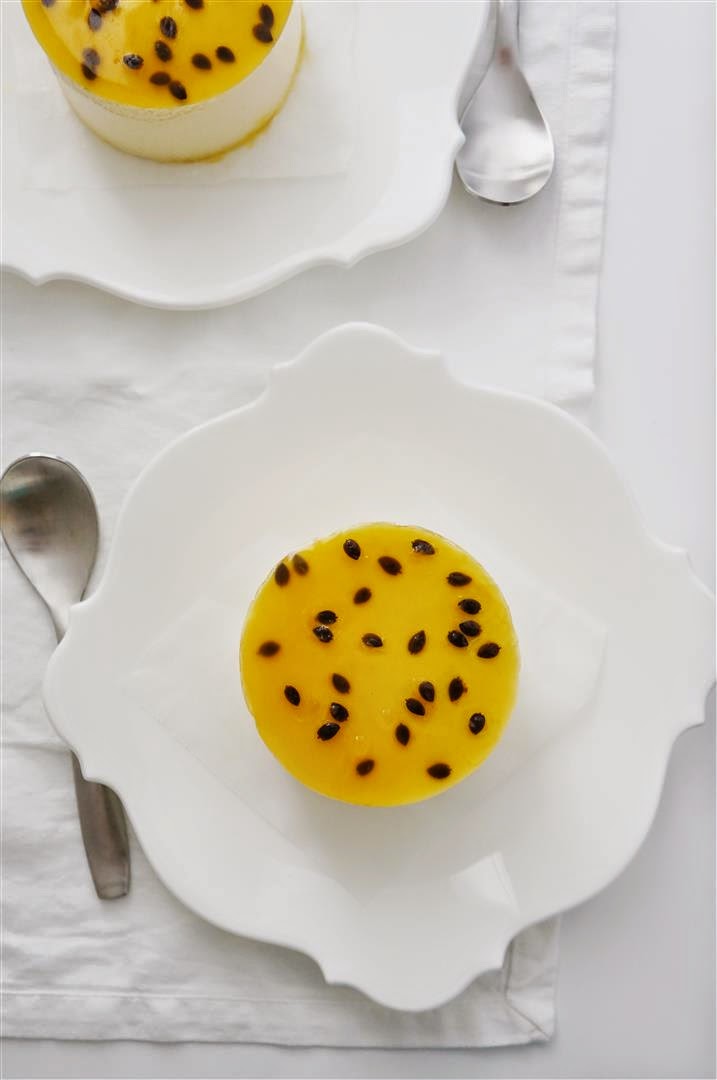

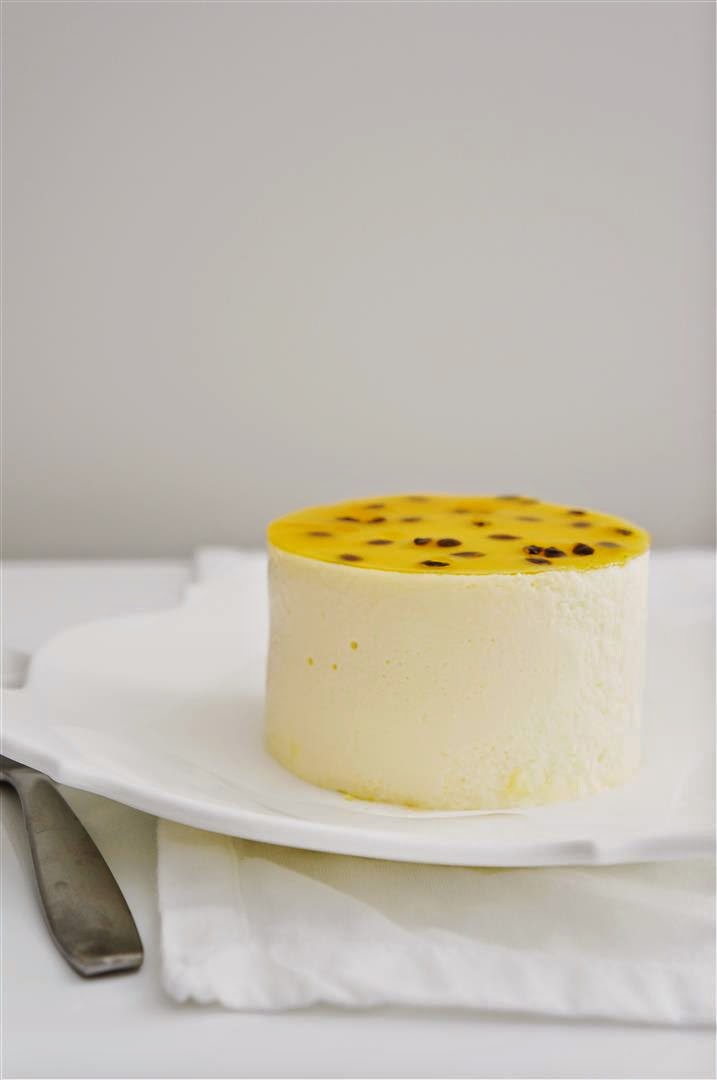

Passionfruit-chocolate Entremet
Makes 8 numbers of 7.5cm diameter cakes
Chocolate Mousse
250ml heavy cream
150 grams 70% dark chocolate, finely chopped
1 large egg, room temperature
2 large egg yolks, room temperature
60 grams caster sugar
2 tablespoons water
To make chocolate mousse:
Using an electric mixer fitted with a whisk attachment, whisk cream to medium peaks. Set whipped cream aside in the fridge while we work on the rest of the chocolate mousse.
Melt the chocolate in a bowl over, not touching, simmering water. Stir occasionally to assist the melting. When the chocolate has melted, remove from the heat and set aside until it cools to 45C.
Meanwhile, place yolks and eggs in the bowl of a mixer fitted with the whisk attachment.
In a small saucepan, combine sugar and water and bring to the boil, swirling pan occasionally to dissolve sugar. Continue to boil until the temperature reaches 115C. Remove pan from heat. Whisk eggs on high speed, and start pouring the syrup in a thin stream into the egg, take care to avoid the spinning whisk. Continue to whisk until the eggs triple in volume and cool to room temperature.
Fold a third of the whipped cream into the cooled chocolate using a hand whisk. (Note: You can be quite rough with folding the cream into the chocolate at this stage. The melted chocolate might start to clump together. Just keep mixing until the mixture comes together and is well combine.) Using a spatula, work as delicately as you can, fold in the rest of the whipped cream until combined, followed by the egg mixture.
Line a cookie tray (or any rectangular baking tray) with baking paper, place 6cm diameter cake rings on top, pour/spoon the chocolate mousse to about 2cm high in the cake rings. Freeze until completely frozen. You will need 8 cake rings. Alternatively, you can spread chocolate mousse in a rectangular baking tray lined with baking paper, to about 2cm high, and when the mousse is completely frozen, cut out rounds of chocolate mousse with a 6cm diameter cookie cutter.
Sugar Syrup
150ml water
100 grams caster sugar
2 tablespoons of orange liqueur (cointreau)
To make sugar syrup:
Combine water and sugar in saucepan, stir, over medium heat until sugar dissolves. Allow to boil for 5 seconds. Cool completely before adding orange liqueur.
Sponge
90 grams egg whites
80 grams caster sugar
80 grams egg yolks
40 grams cake flour
20 grams corn flour
35 grams unsalted butter, melted
To make sponge:
Preheat the oven to 200C (or 180C fan-forced). Line 30x20cm cake pan with baking paper.
Whisk egg white until foamy. Add one quarter of the sugar and whisk for a while. Then add remaining sugar and beat until stiff peaks form and egg whites are glossy. Add egg yolks and whisk until combine.
Combine and sift both flours. Gently fold flours into the batter with a spatula until combine. Fold in melted butter until combine.
Pour batter into the prepared pan, spread evenly, and bake for 15 minutes or until when a toothpick is inserted in the center comes out clean.
When sponge is done and cooled, peel away (by gently rubbing) the layer of brown skin on the top.
Passionfruit Bavarian Cream
2 sheets (6 grams) gelatin
125ml strained passionfruit juice, room temperature
2 egg yolks
50 grams caster sugar
200ml whipping cream
To make passionfruit bavarian cream:
Soften the gelatin in a bowl of cold water.
Whisk egg yolks and sugar in a heatproof bowl until pale and creamy. Add passionfruit juice and whisk to incorporate. Place bowl over a saucepan of gently simmering water, whisk constantly, until the mixture reaches 85C. Remove from heat.
Squeeze the excess water from the gelatin. Stir it into the passionfruit custard. Place the custard over a bowl of ice, stir until it cools to room temperature.
Whisk cream to firm peaks (be careful not to overwhip). Carefully fold whipped cream into the custard with a spatula until combine.
At this stage, start assembling the entremet. The passionfruit bavarian cream needs to be use immediately before the gelatin start to take effect.
To assemble (1):
Line a cookie tray (or any rectangular baking tray) with baking paper. Place 7.5cm diameter X 4.5cm height cake rings on top. You will need 8 cake rings.
Cut out 7cm diameter round cake sponge using cookie cutter. Brush sponge generously with sugar syrup. Place sponge in the centre of cake ring.
Unmold frozen chocolate mousse from cake ring. (Note: I'm still trying to find the best way to do this. At the moment, I put the cake ring with the frozen mousse in a ziplock bag, and dip the ziplock bag in a bowl of hot water for 3 seconds. Then I remove the cake ring from the bag, and gently push the mousse out of the ring onto a baking paper. A bit messy, but it works.)
Place the frozen chocolate mousse on top of the sponge. Pour passionfruit bavarian cream over, and level with a spatula. Place in freezer until completely frozen.
Passionfruit Glaze
150ml strained passionfruit juice (reserve seeds to decorate)
1 tablespoon glucose syrup
2 sheets (6 grams) gelatin
To make passionfruit glaze:
Soften the gelatin in a bowl of cold water.
Warm passionfruit juice and glucose syrup in a saucepan, stir, over medium heat until glucose dissolves. Do not let the passionfruit mixture boil. It should be warm but not hot.
Squeeze the excess water from the gelatin. Stir it into the warm passionfruit mixture.
Allow glaze to cool to room temperature.
To assemble (2):
Place passionfruit seeds randomly over top of the entremets, pour cooled glaze on top, refrigerate until glaze has set completely. Unmold entremets from cake rings.

4.29.2014
Chocolate Mousse Entremet
|  |

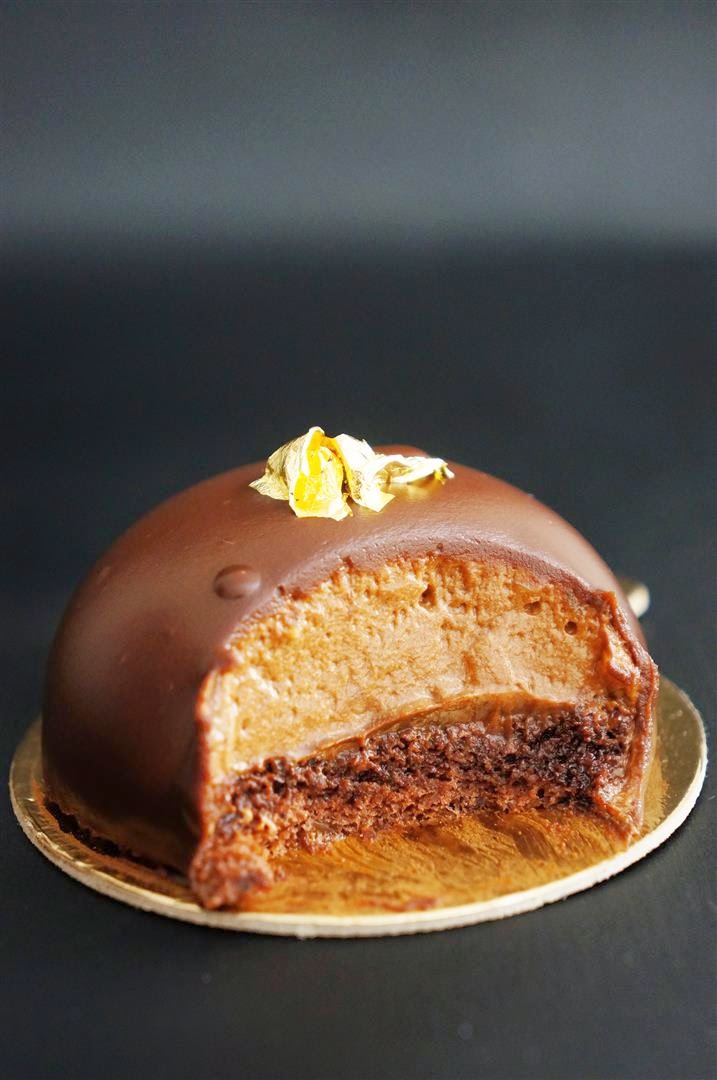
Such an extravagant treat needs a touch of gold. It’s only appropriate. Chocolate mousse entremet is my favourite of all my favourite chocolate desserts. This is a deceptively light but incredibly rich dessert. A single serve will guarantee to keep chocolate craving at bay for a while. It’s not something that I indulge often, which makes it special when I do.
There are 5 components to this entremet; chocolate sponge, chocolate syrup, chocolate mousse, chocolate sauce and chocolate glaze. I love every component in this entremet. I will definitely try to use some of these components for my other entremets in the future.
The recipe below for the chocolate mousse component makes a huge amount of chocolate mousse. I have yet to experiment with making a smaller quantity of chocolate mousse, so I’m not sure how it will work out if we halve the ingredients.
I used a 70mm diameter x 34mm height 6 cavities half semi-sphere silicon mould which I brought from ebay. It’s the same type of mould that you use for British marshmallow tea cakes. The main reason why I use a semi-sphere mould is that the dome shape makes glazing a lot easier. I have made these chocolate mousse entremet using a 70mm diameter round cake ring before, and I found it difficult to glaze along the sides.
The tip to making this chocolate mousse entremet is to use a good quality 70% dark chocolate that you like to eat on its own. This chocolate mousse entremet is only going to be as good as the chocolate that you use.
 |  |
 |  |
 |  |
Chocolate Mousse Entremet
(Adapted from Desserts by Pierre Herme)
Makes 6 numbers of 70mm diameter semi-sphere cakes
Chocolate Sponge
20 grams Dutch-processed Cocoa
20 gram all-purpose flour
16 grams cornstarch
3 large egg whites
100 grams caster sugar
5 large egg yolks
40 grams unsalted butter, melted and cooled to room temperature
To make chocolate sponge:
Preheat oven to 180C conventional (or 160C fan-forced). Line 30cm x 20cm cake pan with baking paper.
Sift and combine cocoa, flour and cornstarch. Set aside.
In a clean bowl, using an electric mixer, whisk egg whites until foamy. Add 50 grams sugar and whisk until stiff peaks form and egg whites are glossy. Set aside.
In a separate bowl, using an electric mixer, whisk egg yolks and the remaining 50 grams sugar until pale and creamy.
Add one-third of whipped egg whites into egg yolk mixture and fold in lightly using a spatula. Fold in the flour mixture, followed by cooled melted butter. Add remainder of the whipped egg whites and fold to incorporate completely.
Bake for 15 to 20 minutes until the cake has risen slightly and feels springy to the touch. Remove from oven. Turn sponge straight from oven onto a sheet of baking paper. Peel off baking paper from the bottom of the sponge. Cover with baking paper, then a tea towel. Set aside to cool completely.
Chocolate Syrup
50 grams caster sugar
10 grams Dutch-processed cocoa
110 ml water
To make chocolate syrup:
Combine sugar, cocoa and water in a saucepan, stir over medium-high heat until sugar dissolves, bring the mixture to the boil. Remove from heat and set aside to cool completely.
Chocolate Mousse
500ml heavy cream
300 grams 70% dark chocolate, finely chopped
2 large eggs, room temperature
5 large egg yolks, room temperature
125 grams caster sugar
45 ml (3 tablespoons) water
1/2 cup slivered almonds, toasted, and finely chopped
To make chocolate mousse:
Using an electric mixer fitted with a whisk attachment, whisk cream to medium peaks. Set whipped cream aside in the fridge while we work on the rest of the chocolate mousse.
Melt the chocolate in a bowl over, not touching, simmering water. Stir occasionally to assist the melting. When the chocolate has melted, remove from the heat and set aside until it cools to 45C.
Meanwhile, place yolks and eggs in the bowl of a mixer fitted with the whisk attachment.
In a small saucepan, combine sugar and water and bring to the boil, swirling pan occasionally to dissolve sugar. Continue to boil until the temperature reaches 115C. Remove pan from heat. Whisk eggs on high speed, and start pouring the syrup in a thin stream into the egg, take care to avoid the spinning whisk. Continue to whisk until the eggs triple in volume and cool to room temperature.
Fold a third of the whipped cream into the cooled chocolate using a hand whisk. (Note: You can be quite rough with folding the cream into the chocolate at this stage. The melted chocolate might start to clump together. Just keep mixing until the mixture comes together and is well combine.) Using a spatula, work as delicately as you can, fold in the rest of the whipped cream until combined, followed by the egg mixture. Finally, fold in the toasted almonds.
It is best the use the mousse now while it is still soft and spreadable.
Chocolate Sauce
60 grams 70% dark chocolate, finely chopped
125 ml water
60 ml heavy cream
25 grams sugar
To make chocolate sauce:
Combine all the ingredients in a small saucepan, stirring constantly over medium-high heat, and bring the mixture to the boil. Reduce heat to low and simmer, stirring constantly until the sauce thickens slightly and coats the back of the spoon. Remove from heat and set aside while you work on the chocolate glaze.
Chocolate Glaze
80 ml heavy cream
100 grams 70% dark chocolate, finely chopped
20 grams unsalted butter, cut into 4 pieces, softened at room temperature
105ml (7 tablespoons) of chocolate sauce, warm or at room temperature
To make chocolate glaze:
Note: Make the glaze only after you have assemble and freeze the chocolate mousse cake.
In a small saucepan over medium heat, bring the heavy cream to a boil. Remove from heat and pour hot cream over the finely chopped chocolate in a heatproof bowl. Allow to sit for 1 minute to let the chocolate melt slightly, then stir slowly in a small circle starting at the centre of the bowl, stirring gently in a circular fashion, gradually increasing the size of the circle. Continue to stir until all the chocolate has melted. Measure the temperature of the mixture, which should be at 60C. If it's too cool, place bowl over simmering water, and remove from heat once the temperature reaches 60C. If it's too hot, allow to cool to 60C.
Stirring gently, blend in butter and the chocolate sauce. Once again, check the temperature of the glaze, which should be between 35C to 40C at which the glaze attains prime pourability. Use glaze immediately.
To assemble:
Spoon or pipe chocolate mousse into the cavities of a 70mm diameter x 34mm height half semi-sphere silicon mould, leaving a gap about the same thickness of the chocolate sponge. (You can use small cake ring if you wish.)
Cut out 70mm diameter round sponge with a cookie cutter. Brush sponge generously with chocolate syrup. Place sponge over the mousse and press down lightly. Wrap the mould well with plastic wrap and freeze until completely frozen (at least 6 hours).
Remove the chocolate mousse cakes from the mould. Place cakes on a cooling rack set on a baking tray. Working very quickly, and in a confident and smooth motion, pour glaze over frozen chocolate mousse cakes. (The glaze will set very quickly and there is no going back to fix up areas that is not covered in the glaze as I found out the hard way.)
Allow the chocolate mousse cake to thaw completely before serving.

10.08.2013
Mini Fraisiers


I finally got my hands on some mini strawberries (which were surprisingly difficult to find) to make mini fraisiers. What I like most about mini strawberries is you can often find organic (aka wonky and weird) shaped strawberries that I think make cute decoration for the mini fraisiers.
Fraisier is a French style strawberry layer cake which typically comprises of four main components- biscuit sponge, simple syrup, crème mousseline and glaze. It’s a little fussy to make, but not overly difficult, and the result is stunning. In fact, you will probably receive a standing ovation for these babies at any dinner party.


Mini Fraisiers
(Adapted from Okashi)
Makes 4 numbers of 7.5cm diameter cakes
Simple Syrup
100 grams caster sugar
100 grams water
2 tablespoons cherry liqueur (or kirsch)
To make simple syrup:
Combine the sugar and water in a small saucepan and cook over medium heat, stirring, until the sugar dissolves. Allow to boil for 5 seconds. Remove from the heat, let cool, and stir in kirsch.
Biscuit Sponge
90 grams egg whites
80 grams caster sugar
80 grams egg yolks
40 grams cake flour
20 grams corn flour
35 grams unsalted butter, melted
To make biscuit sponge:
Preheat the oven to 200 degree celcius (or 180 degree celcius fan-forced). Line 30x20cm cake pan with baking paper.
Whisk egg white until foamy. Add one quarter of the sugar and whisk for a while. Then add remaining sugar and beat until stiff peaks form and egg whites are glossy. Add egg yolks and mix well.
Shift both flours into the bowl and fold using a spatula. Pour melted butter into the batter and fold well.
Pour batter into the prepared pan, spread evenly with a scraper and bake for 15 minutes or until when a toothpick is inserted in the center comes out clean.
When sponge is done and cooled, peel away (by gently rubbing) the layer of brown skin on the top.
Crème Mousseline
350 grams whole milk
1/2 vanilla bean, split lengthwise and scraped for seeds
4 egg yolks
100 grams caster sugar
35 grams plain flour
200 grams unsalted butter, softened
1 tablespoon cherry liqueur (kirsch)
To make crème mousseline:
Place milk, vanilla bean and seeds in a saucepan and bring to boil. Remove from heat and set aside.
In a seperate bowl, whisk egg yolks and sugar until mixture is pale yellow in colour. Whisk in flour until well combined. Remove vanilla bean from milk, gradually pour hot milk into the egg yolk mixture, constantly whisking to combine.
Pour the mixture back into the saucepan. Place over high heat, whisking constantly with a hand whisk until it thickens and becomes smooth and glossy. Remove from heat, transfer pastry cream to a plate, cover with cling film, and place in the freezer to cool for 10 minutes but do not freeze.
Meanwhile, beat butter with an electric mixer until creamy. When the pastry cream is about the same temperature as the butter, add the pastry cream to the butter and beat until combined. Add cherry liqueur and mix well. Spoon creme mousseline into a piping bag fitted with a 1-cm round piping tip.
Raspberry Jelly
5 grams gelatin sheets
200 grams thawed frozen or fresh raspberries
30 grams caster sugar
To make raspberry jelly:
Soak gelatine sheets in a bowl of iced water to soften them.
Meanwhile, puree the raspberries in a blender or food processor. Strain the raspberry through a sieve into a bowl, pressing down with the back of a spoon and discarding the solids. Weigh out 100 grams of strained raspberry puree. Place raspberry puree and sugar in a small saucepan and bring to a simmer. Remove from heat. Squeeze out excess water from gelatine sheets, add gelatin sheets to the raspberry mixture and mix well.
Note: raspberry jelly needs to be use immediately. Make this after you have assemble the cake.
To assemble:
In addition to the components above, you will also need about 250 grams of small strawberries. Reserve 4 cutest and pretties strawberries for decoration. Hull and half the remaining strawberries lengthwise.
Cut out 7.5cm diameter round sponge with cake ring. Cut out a second slightly smaller 6cm diameter round with a cookie cutter. Place cake ring on baking paper. Place larger sponge in cake ring and brush generously with syrup. Arrange strawberries around edge of cake ring with the flat surface against cake ring. Pipe creme mousseline over strawberries. Place smaller sponge on the mousseline cream, press down lightly and brush generously with syrup. Spread a layer of creme mousseline on sponge and level with a spatula. Pour raspberry jelly over the creme mousseline. Refrigerate overnight to set. Decorate with a strawberry on top before serving.
Subscribe to:
Comments (Atom)
Social Icons